


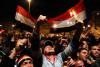


control of oil
Protesters occupy Keystone XL offices in Houston
More than 100 protesters stormed the lobby of TransCanada's Keystone XL office in Houston the morning of Jan. 7, dancing, releasing a cascade of black balloons to represent tar sands oil, and hanging neon orange hazard tape. After being forced out of the lobby by police, the protesters gathered on the sidewalk and performed street theatre in which a "pipe dragon" puppet destroyed homes and poisoned water until being slain by knights representing the grassroots coalition of the Tar Sands Blockade, Idle No More, Earth First and others. The protest was the first held in Houston to oppose the pipeline project, which follows a campaign of tree-sits to actually block pipeline construction in rural areas of Texas. "From the Texas backwoods to the corporate boardrooms, the fight to defend our homes from toxic tar sands will not be ignored," said Ramsey Sprague, a Tar Sands Blockade spokesperson. "We're here today to directly confront the TransCanada executives who’re continuing on with business as usual while making our communities sacrifice zones." (Your Houston News, Jan. 7)
Chuck Hagel: revenge of the paleocons?
Talk of former Republican Nebraska senator Chuck Hagel's imminent nomination as Obama's new Secreaty of Defense has sparked all the predictable reactions—but they don't neatly break down along lines of right and left. MondoWeiss says the pick is "setting up a battle between the left and right flanks of the Israel lobby and between realist supporters of Hagel and his neoconservative detractors." We have, of course, pointed out that "realist" or "pragmatist" is a euphemism for what is more properly termed "paleocon." While the neocons harbor hubristic dreams of re-making the Middle East (and the rest of the world) along lines favorable to the US and Israel, the paleocons favor stability under authoritarian regimes. Neither position is even remotely progressive, and it is frustrating to see ostensible leftists get caught up in a Beltway intrigue between rival currents within the political right.
National Intelligence Council predicts global climate disaster —again
The US National Intelligence Council (NIC) has issued a new report, "Global Trends 2030: Potential Worlds," that emphasizes the rise of China and the risk of catastrophic climate change. An Associated Press summary Dec. 10 says the report finds global terrorism will recede along with the US military footprint in Iraq and Afghanistan, but cyber-attacks will be a growing concern. "The spectacular rise of Asian economies is dramatically altering...US influence," said NIC chairman Christopher Kojm. While the report sees the potential for US-China cooperation on global security, it also warns of resource struggles leading to instability. Under the heading "Stalled Engines," in the "most plausible worst-case scenario, the risks of interstate conflict increase," the report said. "The US draws inward and globalization stalls." The section "Black Swans" foresees extraordinary events that can change the course of history—such as a severe pandemic that could kill millions in a matter of months, or more rapid climate change. The report is optimistic, however, on the prospects for US energy independence. "With shale gas, the US will have sufficient natural gas to meet domestic needs and generate potential global exports for decades to come," it predicts.
Protests rock Sudan, South Sudan...
Six people were injured Dec. 9 as Sudanese police used tear-gas against hundreds of student protesters near the University of Khartoum. The protesters—who chanted the iconic Arab Spring slogan "The people want to overthrow the regime"—were marching to demand justice in the case of four students from the Darfur region who were found drowned in a canal near the campus of Gezira University, south of the capital, on Dec. 7, after they had participated in protests against tuition hikes. The Khartoum protesters marched through the city center, chanting "Killing a student is killing a nation."
Anti-China protests: Vietnam's turn
In the recent wave of anti-Japan protests in China, we've wondered how much of it was genuinely spontaneous and how much (contrary to official appearances) state-instrumented. The signals are even harder to read in Vietnam, where several were actually arrested in anti-China protests Dec. 8. At issue is the contested South China Sea and its oilfields, a question that has (paradoxically, for those who can remember back just to the 1960s) caused Vietnam to tilt to the US in the New Cold War with China. Has the regime's anti-China propaganda (and exploitation of hopes for an oil bonanza to lift the nation out of poverty) created something now a little out of control? Or are even the arrests part of a choreographed game?
Cornhuskers pack Keystone XL hearing
A Dec. 5 public hearing on the proposed re-route of the Keystone XL Pipeline at the Boone County Fairgrounds in the central Nebraska town of Albion was unexpectedly packed with nearly 1,000 people who showed up to sound off on the project. The lone hearing was hosted by the Nebraska Department of Environmental Quality—the only opportunity for impacted residents to weigh in on the DEQ's findings on TransCanada's revised plan for an oil pipeline through the state on its way to Gulf Coast refineries. Oglala Lakota Nation vice president Tom Poor Bear was among those who expressed concerns about groundwater contamination from the project. TransCanada says it has altered the pipeline's path through Nebraska to avoid the environmentally sensitive Sand Hills and some town water wells.
Ecuador: indigenous protests as oil blocs sold
Hundreds of indigenous people gathered outside the Marriott Hotel in Quito on Nov. 28 at the VII Annual Meeting of Oil and Energy, where the Ecuadoran government announced the opening of the XI Round oil auction, offering 13 blocks covering nearly eight million acres of rainforest in the Amazonian provinces of Pastaza and Morona Santiago near the border with Peru. Led by the Confederation of Indigenous Nationalities of Ecuador (CONAIE) and the Confederation of Amazonian Indigenous Nationalities (CONFENIAE) and representing seven indigenous nationalities, the group blocked the entrance to the hotel, to be met by military and private security forces as well as police who used pepper spray. Several indigenous leaders succeeded in entering the meeting and publicly confronted Minister of Non-Renewable Energy Wilson Pastor. "CONFENIAE was never consulted about this," said the organization's Franco Viteri. "Our position on oil extraction is clear: We are absolutely opposed."
Canal intrigues behind Nicaragua border disputes
Nicaraguan President Daniel Ortega announced Dec. 3 that his nation's ships are already exercising sovereignty over resource-rich Caribbean waters claimed by Colombia but granted to the Central American nation by the World Court last week. "At midnight on Sunday [Dec. 2] our ships sailed, they sailed to the recovered area, and by now they have established sovereignty in that whole territory," Ortega said in a message on television and radio. (Reuters, Nov. 26) The ships actually appear to be fishing boats, as Nicaragua has virtually no naval forces—while Colombia has dispatched warships into the disputed waters. Nicaraguan fishing boat captains told the English-language Nicaragua Dispatch that they are "fishing with fear" in the disputed waters beyond the 82nd meridian. "We are doing our part to support the government," said Carlos Javier Goff, president of the Copescharley fishing company out of Puerto Cabezas. "We feel protected by the government and by the international community and, God willing, this won't go to extremes… it won't get beyond words and intimidation."









Recent Updates
1 week 1 day ago
1 week 2 days ago
1 week 3 days ago
1 week 4 days ago
1 week 4 days ago
1 week 4 days ago
1 week 5 days ago
1 week 5 days ago
1 week 5 days ago
1 week 5 days ago