


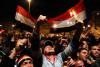


Arab Revolution
Podcast: paradoxes of anarchism and nationalism
In Episode 32 of the CounterVortex podcast, Bill Weinberg reads from George Orwell's 1945 essay "Notes on Nationalism," and explains why despite his anarchist politics he is willing to march under the Mexican flag but not "Old Glory," under the Palestinian flag but not the Israeli, under the Tibetan flag but not that of the People's Republic of China—and under the Free Syrian flag but not that of the Assad dictatorship. The Free Syrian flag flown by the rebels and opposition is the original flag of an independent Syria, and now represents the struggle to free the country from a one-family dynastic dictatorship massively propped up by foreign powers. Weinberg especially calls out the depraved Max Blumenthal for purveying a version of events in Syria starkly at odds with reality. Weinberg invites listeners to join the Syria Solidarity NYC contingent at New York's May Day march, gathering 5 PM at the Sixth Ave. entrance to Central Park. Listen on SoundCloud, and support our podcast via Patreon.
Saudi Arabia executes 37 for terror-related crimes
The Kingdom of Saudi Arabia executed 37 men on April 23 for terrorism-related crimes. Among those killed, 11 were accused of spying on behalf of Iran. Fourteen were convicted for offenses pertaining to anti-government protests. Most of the convicts identified as Shi'ite, and were predominantly from the country's Shia-majority eastern province. Most of the defendants were arrested between 2011-2. One was arrested when he was 16 years old.
Bahrain court sentences 139 on terrorism charges
Bahrain's High Criminal Court on April 16 sentenced 139 terror suspects to prison terms ranging from three years to life in prison. The court also revoked the citizenship of all but one of those convicted. The accused were sad to be part of a network organized and trained by Iran’s Revolutionary Guard (IRGC), an arm of the Iranian state recently designated by the US Treasury Department as a "terrorist organization." Bahrain's ruling family is Sunni and most of those sentenced are believed to be Shia.
Sudan: new Arab Revolution wins another round
Sudan's longtime ruler Omar al-Bashir was removed from power and arrested by the military April 11, following months of popular protests that culminated in clashes between his loyalist security branches and the military. In the prior category is the feared National Intelligence and Security Service (NISS), which two days earlier was met with resistance from army troops when it tried to us repression to clear a protest encampment outside the armed forces headquarters in Khartoum. The NISS, perhaps under pressure from the military, now says the hundreds arrested in the weeks of protests will be released—although it did not say when. Armored vehicles from the military's elite Rapid Support Forces have taken strategic positions around the capital. But protesters continue to fill the streets, chanting: "It has fallen, we won." Opposition leaders are clear they will continue to oppose any attempt at military rule.
Algeria's victory: Arab Revolution reawakens?
Algerians flooded into the streets in celebration April 2 as long-ruling President Abdelaziz Bouteflika announced his resignation following weeks of protests in cities across the country. The ailing Bouteflika clearly stepped down to avoid being deposed by armed forces. Just hours before his announcement, Lt. Gen. Ahmed Gaid Salah, commander of the National Popular Army, called for "immediate" application of Article 102 of the constitution, which calls for the removal of a president who is too incapacitated to serve. The resignation also came four days after some million protesters filled the streets of Algiers for a "Friday of the Steadfastness"—the sixth consecutive Friday of demonstrations calling for an end to Bouteflika's rule. But a popular chant at the protests was "We want the implementation of Article 7 of the constitution"—which stipulates that "the people are the source of all power." The movement is demanding an end to the entrenched military-dominated regime altogether.
Egyptian activist Alaa Abdel Fattah released
Alaa Abdel Fattah, a leading Egyptian pro-democracy activist, was released from prison on March 29 after serving a five-year sentence, according to his family and lawyer. Fattah was a leading voice among young Egyptians in the uprising of 2011, which ousted president Hosni Mubarak from power after a 30-year period of rule. A prominent blogger and software engineer, he was once described by authorities as "the icon of the revolution."
Escalation in Gaza; Orwell in Golan
An Egypt-mediated ceasefire between Israel and Palestinian factions in the besieged Gaza Strip was declared March 26 following two days of Israeli air-strikes and Palestinian rocket fire. Israeli warplanes carried out dozens of strikes across the Strip, while at least 50 rockets were fired from Gaza into southern Israel. Residential and commercial buildings were struck by Israeli warplanes, with at least seven Palestinians reported injured. The escalation came after a Gaza rocket struck an house north of Tel Aviv, injuring seven Israelis. (Ma'an) With the air-strikes underway, Israeli Prime Minister Benjamin Netanyahu met with Donald Trump in Washington for the signing of a presidential proclamation officially recognizing the occupied Golan Heights as Israeli territory. At the joint press conference, Trump said, "We do not want to see another attack like the one suffered this morning north of Tel Aviv," adding, "We will confront the poison of anti-Semitism." Netanyahu called Trump's recognition a "diplomatic victory," adding that "Israel won the Golan Heights in a just war of defense." (Ma'an)
Assad to The Hague —hope at last?
Even amid growing media portrayals that Bashar Assad has won the war in Syria, the first real hope has emerged that the dictator will face war crimes charges before the International Criminal Court. A group of Syrian refugees who fled to Jordan after surviving torture and massacres this week submitted dossiers of evidence to the ICC in an attempt to prosecute Assad. Although Syria is not a signatory to the Rome Statute, which establishes the court's jurisdiction, lawyers in London are citing recent precedent set by the ICC in extending jurisdiction for the crime of forcible population transfers across international borders. London barrister Rodney Dixon of Temple Garden Chambers, representing the group of 28 refugees, said: "The ICC exists precisely to bring justice to the victims of these most brutal international crimes... There is a jurisdictional gateway that has opened up finally for the ICC prosecutor to investigate the perpetrators who are most responsible." In his letter to chief prosecutor Fatou Bensouda, Dixon notes last year's ICC ruling on Rohingya refugees, allowing an investigation of non-signatory Burma to proceed. (The Guardian, BBC News)









Recent Updates
1 day 2 hours ago
1 day 21 hours ago
2 days 5 hours ago
2 days 19 hours ago
2 days 19 hours ago
1 week 5 days ago
1 week 6 days ago
2 weeks 1 day ago
2 weeks 1 day ago
2 weeks 1 day ago