




Central Africa
Police 'anti-crime' extermination campaign in DRC
The decades-long civil war in the Democratic Republic of Congo shows signs of winding down, but is apparently leaving in its wake a good old "anti-crime" police state that sees impoverished youth as a threat and seeks to exterminate them. Human Rights Watch reported last month that police in the DRC summarily killed at least 51 youth and "forcibly disappeared" 33 others during an anti-crime campaign that began a year ago. "Operation Likofi," which lasted from November 2013 to February 2014, was officially a crackdown on criminal gangs in Congo's capital, Kinshasa. HRW's report, "Operation Likofi: Police Killings and Enforced Disappearances in Kinshasa," details how uniformed police, often wearing masks, dragged suspected gang members—known as kuluna—from their homes at night and executed them. Police shot and killed the unarmed young men and boys outside their homes, in open markets where they slept or worked, or in nearby fields or empty lots. Many others were taken without warrants to unknown locations, never to be seen again.
Jihadist hand seen in new Congo massacres
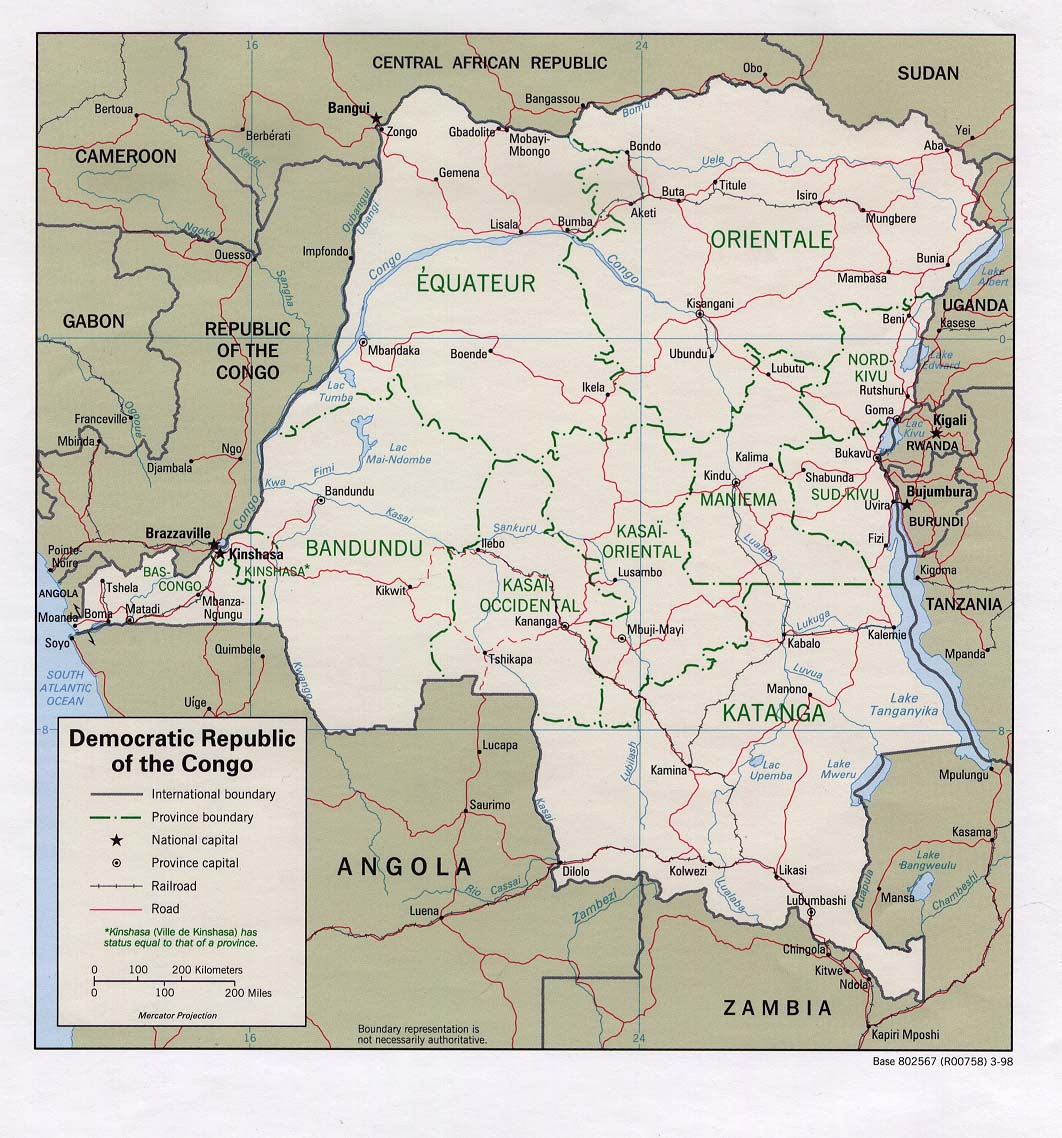
The murders of more than 250 men, women and children in eastern Democratic Republic of Congo’s (DRC) Beni Territory in recent weeks have widely been blamed on an Islamist insurgency of Ugandan origin known as the Alliance of Democratic Forces-NALU (ADF-NALU). But several armed groups and racketeering gangs are active in the area and the culprits of these killings have not been incontrovertibly identified. The killings were carried out, in various episodes between Oct. 2 and Dec. 7, using knives, machetes and hoes, in parts of Nord Kivu province, on some occasions in close proximity to positions held by the national army (FARDC) and bases of the UN peacekeeping mission in DRC (MONUSCO). Just in the 48 hours leading up to the night of Dec. 7, 50 people were killed in two parts of Beni territory, according to Civil Society in North Kivu, a local organization. (See map.)
ICC upholds Lubanga conviction
The International Criminal Court (ICC) on Dec. 1 upheld the conviction and sentence of former Democratic Republic of Congo (DRC) militia leader Thomas Lubanga Dyilo. Lubanga was convicted in March 2012 for the war crimes of enlisting and conscripting children under the age of 15 and using them to participate actively in hostilities. He received a 14-year prison sentence from the ICC. Lubanga's lawyers were seeking to have the conviction and the sentence replaced with an acquittal. Lubanga has spent the past eight years in prison, all of which count towards the 14-year total. He will serve out the remainder of the sentence in one of the ICC's 122 member states and will be eligible for early release next year.
ICC opens new Central African Republic inquiry
The head of the Office of the Prosecutor at the International Criminal Court (ICC), Fatou Bensouda, on Sept. 24 announced the office will open a second investigation (PDF) into the situation in the Central African Republic (CAR) with respect to crimes allegedly committed since 2012. Alleged crimes against humanity include murder, torture, rape, attacking personnel or objects involved in a humanitarian assistance missions, pillage, and the use of child soldiers under the age of 15. The ICC report states there is reasonable belief that both sides of the conflict may be culpable for crimes against humanity. Bensouda opened a preliminary examination in February 2014 due to escalating violence in CAR, and in May the transitional government of CAR led by Catherine Samba-Panza urged the ICC to pursue the investigation. Prosecutor Bensouda intends to accumulate criminal evidence to identify and prosecute those responsible for the most serious crimes:
ICC convicts Congo militia leader of war crimes
The International Criminal Court (ICC) on March 7 found (PDF) Congolese militia leader Germain Katanga guilty of four counts of war crimes and one count of crime against humanity. The crimes were committed during an attack on a village in a diamond-rich region of Congo in 2003, in which approximately 200 civilians were killed and some sexually assaulted. During a public hearing Friday, presiding judge Bruno Cotte delivered a summary of the judgment. He explained that based on the evidence presented and witness testimony, it had been established beyond a reasonable doubt that Katanga made a "significant contribution to the commission of crimes by the Ngiti militia." The court acquitted Katanga of the other charges, including sexual slavery, using child soldiers and rape. Katanga is only the second person to be convicted since the court's inception in 2002.
France opens country's first Rwanda genocide trial
A French court opened trial Feb. 4 against former Rwandan intelligence chief Pascal Simbikangwa in the country's first trial of a suspect in the 1994 Rwanda genocide. Simbikangwa, 54, is charged with arming and directing Hutu extremists in the violence that claimed the lives of an estimated half a million ethnic Tutsi. He was arrested in 2008 while in hiding on the French island of Mayotte. A paraplegic since 1986, Simbikangwa faces a potential life sentence for complicity in the genocide and crimes against humanity. The current president of Rwanda, Paul Kagame, has accused France of supporting the Hutu militia and harboring fugitives who fled to France in the years following the genocide. This trial is seen as an important first step in repairing relations between the embittered nations.
Exodus adds to Central African Republic crisis
Almost 20,000 people of Chadian origin have fled violence in the Central African Republic (CAR) in recent weeks, and many more are expected to join the exodus, which is straining humanitarian capacity in Chad, a country many of those fleeing have never lived in. "Those of us who were born here are Central Africans, but we are treated like foreigners. We have never seen Chad but have to go there for our own protection," said Awa Rabilou, one of thousands of people camped for the last two weeks outside the Chadian embassy in Bangui, waiting for a place on a truck headed for Chad. "Our houses were burnt. We left with only the clothes we were wearing. They even threw grenades at us. It was people who joined the anti-balaka who did this. If we stay in our neighborhood, they will kill us," added Rabilou.
Congo: intervention force against Islamist rebels?
The bodies of at least 21 people, including women and children, were found after an attack near Beni in eastern Democratic Republic of Congo, the UN "peacekeeping" mission MONUSCO said Dec. 16. Local civil organization North Kivu Civil Society blamed the massacre on Ugandan Islamist group ADF-NALU. (AFP, Dec. 17) Days earlier, MONUSCO announced that following the defeat of M23 rebels in North Kivu province, UN and government forces will shift focus to northeastern Orientale, giving armed groups there a two-week ultimatum to surrender their weapons and return to civilian life. Said MONUSCO commander Gen. Carlos Alberto dos Santos Cruz: "We are going to use force. We will do everything we can to allow the FARDC [DRC armed forces] to take on these armed groups." He named ADF-NALU, along with the Congolese People's Liberation Army (ALPCU) and the Patriotic Resistance Front in Ituri (FRPI). (IRIN, Dec. 13) The Allied Democratic Forces-National Army for the Liberation of Uganda has operated in the DRC-Uganda borderlands since 1995. (International Crisis Group)







Recent Updates
4 days 19 hours ago
5 days 14 hours ago
5 days 22 hours ago
6 days 12 hours ago
6 days 12 hours ago
2 weeks 2 days ago
2 weeks 3 days ago
2 weeks 4 days ago
2 weeks 5 days ago
2 weeks 5 days ago