



Africa Theater
Protests rock Swaziland
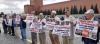
Inspired by the Arab Spring, protesters in Swaziland are calling for King Mswati III—Africa’s last absolute monarch—to allow multi-party democracy and rescind salary cuts to public employees. The king has not responded publicly, but his army and police have unleashed a heavy crackdown, including preemptive arrests of labor leaders, journalists, and student activists, as well as the use of tear gas and water cannons on the streets. On April 13, the third day of protests, labor and student leaders announced a pause in the campaign to rethink their strategy, but some warned against backing down. "You can choose, if you want to, to end the protests and in the process send a clear a message to your government that ... the best way to deal with protests is clubs and tear gas," the Swaziland Support Network (SSN) in a statement. "The alternative is fighting back." (CSM, April 14)
French forces aid in capture of besieged Ivory Coast leader Gbagbo
French special forces April 11 aided in the capture of Ivory Coast leader Laurent Gbagbo in Abidjan. Gbagbo surrendered after French tanks moved in on his residence while it was surrounded by opposition leader Alassane Ouattara's forces. Gbagbo had refused to leave office since his defeat in presidential elections last November. France deployed forces to the Ivory Coast as part of a UN-backed peacekeeping mission to stem the post-electoral violence. It was reported that French special forces captured Gbagbo and turned him over to Ouattar's forces, but Youssoufou Bamba, UN envoy of president-elect Ouattara, said it was the opposition leader's forces who made the arrest. However, there are still conflicting reports over what forces actually made the arrest. Gbagbo is being held in a hotel with his family under the protection of UN and pro-Ouattara forces. France claims that its intervention in its former colony is only at the UN's request.
Federal judge sentences Somali pirate to 25 years in prison
A Somali pirate was sentenced by the US District Court for the District of Columbia on April 7 to 25 years in prison for attacking a Danish ship off the coast of Somalia in 2008, for which he and other pirates received a $1.7 million ransom. US Department of Justice officials say Jama Idle Ibrahim, who pleaded guilty last year to conspiracy to commit piracy and conspiracy to use a firearm during a violent crime, and other Somali men were armed with AK-47s and rocket-propelled grenades when they seized the Danish vessel MV CEC Future and held its 13-member crew for ransom. Ibrahim's sentence will run concurrent with the 30-year sentence he received in November, stemming from a failed assault on the Navy's USS Ashland.
Ivory Coast: reprisals feared as pro-Ouattara forces march on Abidjan
Forces loyal to president-elect Alassane Ouattara took Ivory Coast's administrative capital Yamoussoukro and principal port San Pedro on March 31, and are currently moving on Abidjan, the country's principal city—where rumors are flying about the imminent fall of Laurent Gbagbo, who has refused to cede power. Ouattara, the internationally recognized president, said Gbagbo would not be harmed if he agreed to leave. Civilian residents throughout Abidjan, however, do not have such assurances.
UN fears "crimes against humanity" in Ivory Coast
The shelling of a market in Abidjan, Ivory Coast, on March 17, which killed at least 25 people and wounded 40, may be a crime against humanity, the United Nations says. The UN blamed forces loyal to the incumbent president, Laurent Gbagbo, whose refusal to cede power set off the crisis. The market was in the suburb of Abobo, a stronghold of Alassane Ouattara, the internationally recognized winner of the Nov. 28 presidential race. “Such an act, perpetrated against civilians, could constitute a crime against humanity,” the UN said in a statement. Secretary General Ban Ki-moon urged the Security Council to “take further measures with regard to the Ivorian individuals who are instigating, orchestrating and committing the violence."
Youth uprising in Burkina Faso
Some 20 prisoners escaped in Burkina Faso on March 8 after middle and high school students set four police stations on fire to protest the killing of four youth by police last month. The police stations were burned down in the towns of Yako, Koupela, Gourcy and Dori. Peaceful protests were held in Bobo Dioulasso, Burkina Faso's second city, and six other towns. Six people, including four students and a police officer, were killed in riots in late February in the town of Koudougou, 100 kilometers west of the capital Ouagadougou, after a student died in disputed circumstances. (SAPA, March 8)
Sudan: Khartoum sponsoring warlords to shift borders before secession?
Clashes between South Sudanese forces and two separate rebel militias have left at least 90 people dead, an SPLA spokesman said March 7. In Jonglei state, the SPLA battled a militia loyal to renegade southern general George Athor, while in neighboring Upper Nile state SPLA troops fought an apparently allied militia under a warlord who was formerly backed by Khartoum, and whose name is rendered variously as Ulony or Oliny. Despite obvious fears that Khartoum is sponsoring rebel militias to take back lands from the SPLA before South Sudan's formal secession in July, Jonglei governor Kuol Manyang said that the fighting was due to a "long-time dispute" over land between the communities of Ayual and Dacuek. The clashes come despite the an offer to let the militias join the SPLA as part of South Sudan President Salva Kiir's amnesty to rebel fighters in October. (Middle East Online, BBC News, March 7; Sudan Tribune, March 4)
Coup attempt crushed in Comoros
Government troops in the Comoros killed or repelled white mercenaries who tried to seize control of part of the Indian Ocean archipelago nation Feb. 22. The apparent coup attempt was launched in the island of Moheli in the early hours by about 20 French-speaking soldiers wearing balaclavas who took over government buildings and cut telephone lines. The troops were reported to have distributed leaflets written in English, linking President Azaly Assoumani to Osama bin Laden.






Recent Updates
2 days 23 hours ago
3 days 18 hours ago
4 days 2 hours ago
4 days 16 hours ago
4 days 16 hours ago
2 weeks 17 hours ago
2 weeks 1 day ago
2 weeks 3 days ago
2 weeks 3 days ago
2 weeks 3 days ago