





mining
Colombia: no ceasefire during peace talks
Colombia's President Juan Manuel Santos rejected a proposal Sept. 6 by the FARC rebels for a bilateral ceasefire during talks set to begin in Norway next month, aimed at bringing an end to the country's long civil war. In an address at Tolemaida military base outside Bogotá, Santos pledged that the counter-insurgency campaign would continue across "every centimeter" of the country. "I have asked that military operations be intensified, that there will be no ceasefire of any kind," Santos said. "We won't cede anything at all until we reach the final agreement. That should be very clear."
OAS rights body presses for truth in Yanomami massacre claims
The Inter-American Commission on Human Rights (IACHR, or CIDH in Spanish), a body of the Organization of American States (OAS), issued a statement Sept. 5 urging Venezuelan authorities "to conduct a thorough investigation" into assertions made by representatives of the Horonami Yanomami organization that an isolated Yanomami community in southern Amazonas state was massacred by outlaw gold-miners who came across the Brazilian border. The statement came days after Venezuela's Minister for Indigenous People Nicia Maldonado and Justice Minister Tareck el Aissami both said that teams sent to the region had found no evidence of a massacre. The IACHR called on both Venezuela and Brazil to pursue a deeper investigation, and report back their findings to the international body.
Venezuelan authorities deny Yanomami massacre
Venezuelan officials investigating a reported mass killing of Yanomami indigenous people say the have found no evidence of the attack. Minister of Indigenous Peoples Nicia Maldonado said a team travelled to the area by helicopter and failed to locate the bodies witnesses had described finding. "No evidence of any death was found," Maldonado said on state TV. "There is no evidence of murder or fire in either houses or shabonos [communal dwellings] in the communities where the alleged crime took place." Gen. José Eliecer Pinto of the National Guard told Ultimas Noticias newspaper that he had visited four indigenous communities along with other officials and that "everything is fine there." Officials expressed skepticism at claims that outlaw gold miners came across the border from Brazil to attack the settlemet from the air by helicopter. "It would be extremely hard to do," said Gen. Rafael Zambrano, commander of the Venezuelan army unit responsible for the region.
Peru: mine tailing spill contaminates Río Huallaga
Venezuela: Yanomami massacred by outlaw miners
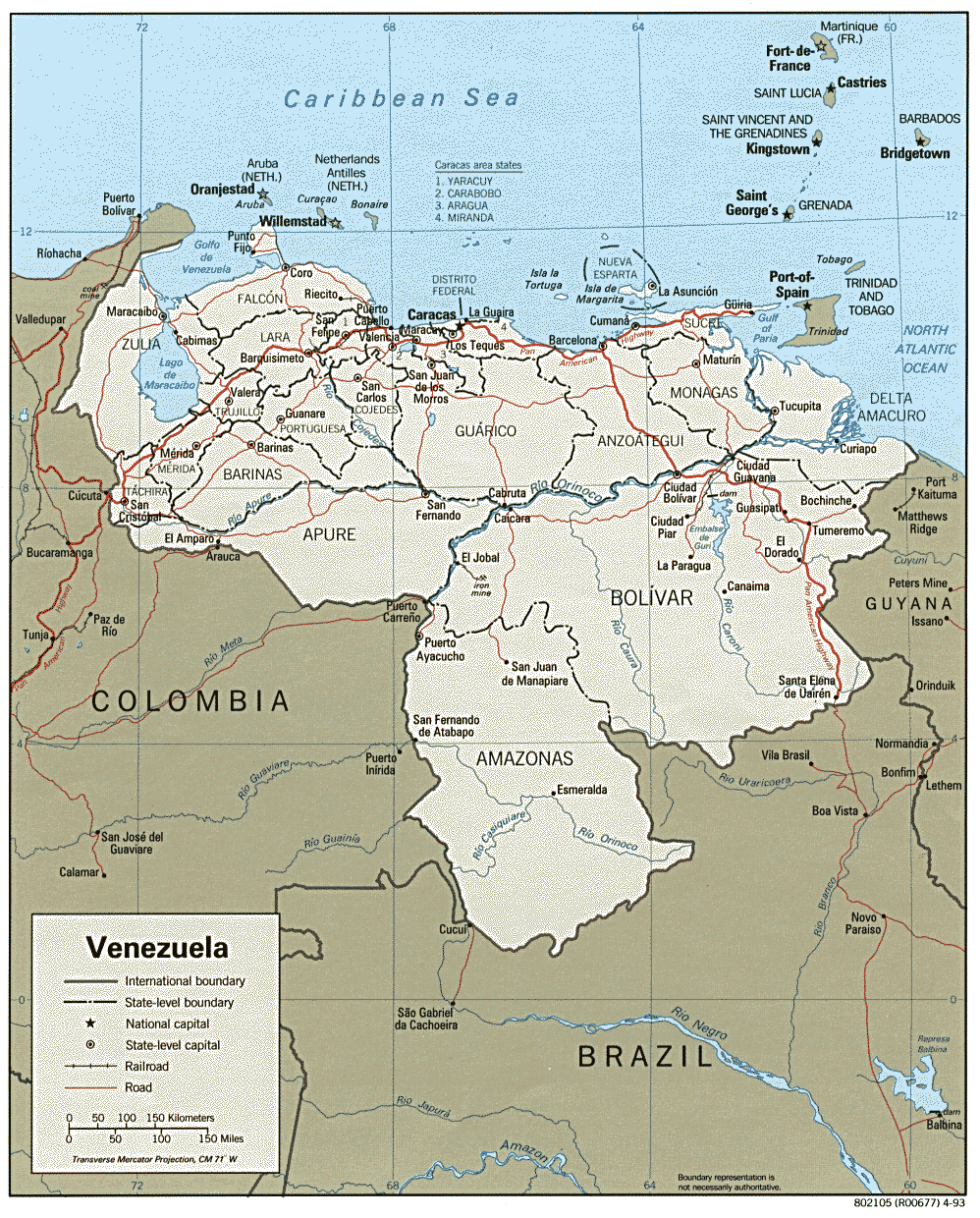
Authorities in Venezuela pledge to investigate breaking reports that illegal gold miners in southern Amazonas state carried out a "massacre" of an isolated Yanomami indigenous community. Witnesses of the aftermath described finding "burnt bodies and bones" at the community of Irotatheri, Alto Orinoco municipality, near the Brazilian border in the headwaters of the Río Ocamo, an Orinoco tributary. (See iTouch Map; Venezuela political map) Blame is being placed on illegal miners, known as garimpeiros, who cross the border from Brazil to prospect for gold and have attacked indigenous peoples before.
South Africa: Marikana massacre survivors charged with murder
Another one to file under "Orwell would shit." From BBC News, Aug. 30:
Workers arrested at South Africa's Marikana mine have been charged in court with the murder of 34 of their colleagues shot by police.
Bolivia: Aymara communities occupy Oruro mine
The comunarios (communal peasants) of Marka La Joya, on the morning of Aug. 21 initiated an occupation of the installations of the Inti Raymi Mining Company at La Titina, outside the Altiplano city of Oruro, in protest of the pollution of local water sources with cyanide and other toxins. Traditional Aymara authorities of the ayllus (agricultural communities) of Jach'a Carangas, Jakisa, Sura and Uru, which together constitute Marka La Joya, charged that the government of President Evo Morales and the Plurinational Legislative Assembly are making laws that favor the mineral industry, without the involvement of indigenous communities impacted by mining projects. "We view with profound concern...that the government, through the corresponding ministries, has drawn up—without consultation—the projects of the Mining Laws, the Rights of Mother Earth, Water, Prior Consultation...without the participation of social sectors, and especially of the indigenous nations and original peoples," the statement read. (OCMAL, OIDEC, Aug. 21; La Opinón, Cochabamba, Aug. 20)
Peru: Newmont Mining to abandon Conga project?
In an interview with Dow Jones last week, Richard O'Brien, CEO of Colorado-based Newmont Mining Corp. acknowledged that the conditions do not exist to move ahead with the $5 billion Conga gold and copper project in Cajamarca, Peru. O'Brien said there must be a "consistent environment that we would need for the successful conduct of both mining and all those things that go with mining, whether that is transporting people or equipment. Right now we don't see that environment in Conga. It will take a significant change to make that happen." (Fox Business News, Aug. 17) This week, a new 48-hour paro (civil strike) has been declared to oppose the Conga project in Cajamarca region, much of which remains under a state of emergency. To kick off the strike Aug. 22, hundreds of campesinos marched in the province of Bambamarca, in defiance of a ban on public protests. The marchers were mostly ronderos (members of the self-defense patrol) the outlying village of El Tambo, which is within the impact zone of the proposed mine. The campesinos held a gathering at Laguna Namococha, one of the highland lakes that would be degraded by the project. (La Republica, Aug. 22)









Recent Updates
7 hours 26 min ago
1 day 6 hours ago
1 day 8 hours ago
5 days 21 hours ago
5 days 22 hours ago
5 days 22 hours ago
5 days 22 hours ago
5 days 22 hours ago
5 days 22 hours ago
5 days 22 hours ago