





Amazon Theater
Peru: first 'prior consultations' on Amazon oil development
Peru's official human rights ombudsman, Defender of the People Eduardo Vega, is set to convene the first "prior consultation" with Amazonian indigenous peoples on oil development in their territory, under terms of a new law passed earlier this year establishing protocols for the process. The consultation concerns a planned new round of oil contracts planned for Bloc 1AB, currently held by Argentine firm Pluspetrol, in the watersheds of the Pastaza, Corrientes and Tigre rivers in the northeast of Loreto region. The Regional Organization of Indigenous Peoples of the East (ORPIO), with an office in the city of Iquitos, it to represent the impacted indigenous peoples. Vega pledged the process will be executed "with the utmost clarity so that rights of the indigenous peoples will be respected and the same process can serve for other consultations that will subsequently be carried out."
OAS rights body presses for truth in Yanomami massacre claims
The Inter-American Commission on Human Rights (IACHR, or CIDH in Spanish), a body of the Organization of American States (OAS), issued a statement Sept. 5 urging Venezuelan authorities "to conduct a thorough investigation" into assertions made by representatives of the Horonami Yanomami organization that an isolated Yanomami community in southern Amazonas state was massacred by outlaw gold-miners who came across the Brazilian border. The statement came days after Venezuela's Minister for Indigenous People Nicia Maldonado and Justice Minister Tareck el Aissami both said that teams sent to the region had found no evidence of a massacre. The IACHR called on both Venezuela and Brazil to pursue a deeper investigation, and report back their findings to the international body.
Venezuelan authorities deny Yanomami massacre
Venezuelan officials investigating a reported mass killing of Yanomami indigenous people say the have found no evidence of the attack. Minister of Indigenous Peoples Nicia Maldonado said a team travelled to the area by helicopter and failed to locate the bodies witnesses had described finding. "No evidence of any death was found," Maldonado said on state TV. "There is no evidence of murder or fire in either houses or shabonos [communal dwellings] in the communities where the alleged crime took place." Gen. José Eliecer Pinto of the National Guard told Ultimas Noticias newspaper that he had visited four indigenous communities along with other officials and that "everything is fine there." Officials expressed skepticism at claims that outlaw gold miners came across the border from Brazil to attack the settlemet from the air by helicopter. "It would be extremely hard to do," said Gen. Rafael Zambrano, commander of the Venezuelan army unit responsible for the region.
Bolivia: TIPNIS consultation extended amid protests over militarization
Bolivia's lower house Chamber of Deputies on Sept. 4 voted to extend until Dec. 7 the process of consultation with impacted indigenous communities on the controversial highway through the Isiboro-Sécure Indigenous Territory and National Park (TIPNIS), days after the deadline for the consultation process ran out. The Aug. 26 deadline was set by Law 222, passed in February to establish a framework for the consultation—above the protests of indigenous communities opposed to the project.
Brazil: quilombo threatened by rancher gunmen
Amnesty International reports that 45 families from the Quilombo Pontes community in Pirapemas municipality, in Brazil's northeastern Maranhão state, are being systematically threatened and intimidated by gunmen who are patrolling the area. The gunmen are employed by local ranchers who are trying to push the community off the land. Crops and property belonging to the community have been destroyed, and its members are now struggling to provide food for their families. The Pontes community was officially recognised as a quilombo territory—communities of descendants of escaped slaves—in December 2011, but the authorities have not intervened to guarantee the integrity of their land.
Venezuela: Yanomami massacred by outlaw miners
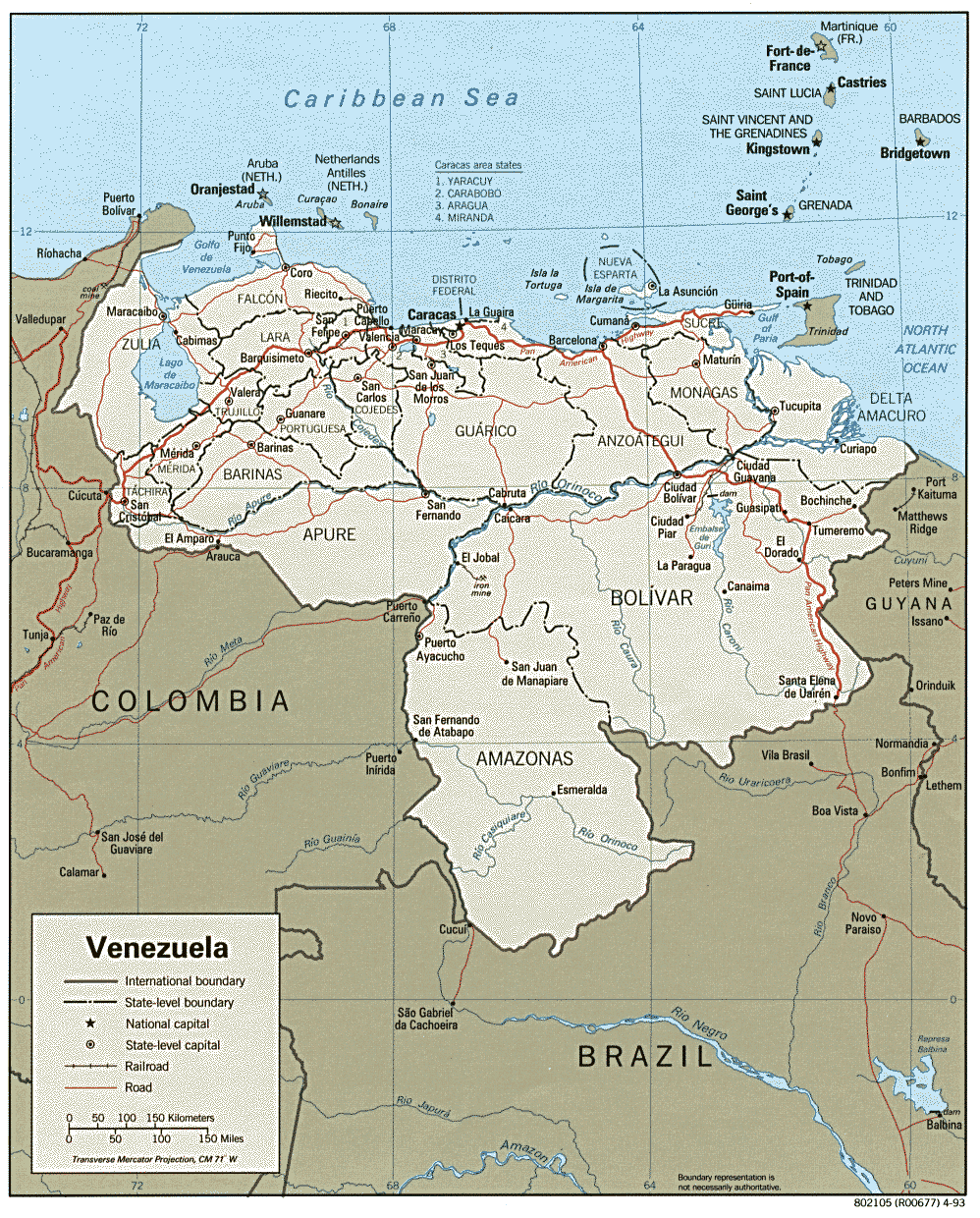
Authorities in Venezuela pledge to investigate breaking reports that illegal gold miners in southern Amazonas state carried out a "massacre" of an isolated Yanomami indigenous community. Witnesses of the aftermath described finding "burnt bodies and bones" at the community of Irotatheri, Alto Orinoco municipality, near the Brazilian border in the headwaters of the Río Ocamo, an Orinoco tributary. (See iTouch Map; Venezuela political map) Blame is being placed on illegal miners, known as garimpeiros, who cross the border from Brazil to prospect for gold and have attacked indigenous peoples before.
Brazil: high court orders release of rancher convicted in Dorothy Stang slaying
Brazil's Supreme Court on Aug. 22 ordered the release of Amazon rancher Regivaldo Galvão, convicted in the 2005 killing of US nun and rainforest activist Dorothy Stang. In 2010, Galvão was convicted by a court in Belém, Pará state, of ordering Stang's death, and sentenced to 30 years. The following year, the Pará court ordered that he start serving his term immediately, even while pursuing an appeal of his conviction. But the Supreme Court ruled that Galvão had the right to remain free pending the outcome of his appeal.
Peru: Shining Path control outlaw gold operations?
Five soldiers were killed in an attack by presumed Shining Path guerrillas Aug. 15 on a military base in Mazangaro, Junin region, in Peru's Apurimac-Ene River Valley (VRAE). According to La Republica, the attack could be in response to the army's seizure three days prior to the assault of 800 kilos of precursor chemicals used in the production of cocaine. (InSight Crime, Aug. 16) Two days after the attack, Peru's special anti-terrorism prosecutor, Julio Galindo, asserted that the Shining Path column in the coca-growing region was financed not only by the narco traffic, but by illegal gold-mining and logging. He said the state is attempting to crack down on the guerilla column's money laundering networks, which he characterized as "very technical." He also referred to the area of guerilla operations as the VRAEM—including the Mantaro River in the acronym, a western tributary of the Apurimac-Ene, in an implicit acknowledgement that the insurgency is spreading. (Perú21, Aug. 18; El Comercio, Aug. 17)










Recent Updates
1 day 12 hours ago
2 days 8 hours ago
2 days 15 hours ago
5 days 16 hours ago
6 days 14 hours ago
6 days 16 hours ago
1 week 4 days ago
1 week 4 days ago
1 week 4 days ago
1 week 4 days ago