



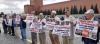

European Theater
Paris: 1961 massacre of Algerians commemorated —and officially denied
Politicians, historians and others gathered in Paris Oct. 17 to mark the 50th anniversary of a police massacre of Algerian protesters that has become one of the most shameful episodes of modern French history. Although authorities still only acknowledge three deaths, estimates by historians and activists range from 50 to 300—many of the victims beaten and thrown into the river Seine. In an unprecedented move by a French politician, newly named Socialist presidential candidate François Hollande officiated at the rally, and threw a single red rose into the Seine from the bridge at Clichy, the suburb where many of the victims lived. Afterwards he unveiled a plaque engraved with the words: "From this bridge and other bridges in the Paris region, Algerian demonstrators were thrown into the Seine on the 17 October 1961, victims of a blind repression. In their memory."
Athens: riots mark opening of Greek general strike
Greek protesters clashed with police in central Athens after Prime Minister George Papandreou vowed to push through a further round of austerity measures. Reverberations of tear-gas rounds echoed across Syntagma Square as helmeted riot police maintained a protective cordon around the parliament building. Some 70,000 converged on Syntagma at the start of a declared 48-hour general strike. (Bloomberg, SETimes, Oct. 19)
Anti-austerity protesters return to Madrid's Puerta del Sol
Thousands of protesters returned to Madrid's central square, the Puerta del Sol, Oct. 6, as students, parents and teachers joined in a massive march against education spending cuts by the Spanish capital's provincial government. "Defend public education, make cuts for bankers," read the lead banner, while other slogans included "Yes, there is money, but the bankers have it," "Less vultures and more desks," and "Education is not a waste, it's an investment." Some 85% of the city's students walked out of class for the march. Media accounts of the march's size varied widely, with AFP putting it at 4,000, and El País claiming 68,000.
Anti-Roma protests rock Bulgaria
More than 160 people were arrested in Bulgaria Sept. 27, in a second night of protests against the Balkan country's large Roma minority. The protests were sparked by the hit-and-run killing of a 19-year-old man by an apparent associate of the local self-proclaimed "Gypsy King" Kiril Rashkov in the village of Katunitsa near Plovdiv, but quickly spread to cities and towns throughout the country. (See map.) Protests dwindled the night of the 28th, after Rashkov was arrested. More than 2,000 marched in Sofia at the height of the protests. At least one incident of skinheads attacking a Roma man and his young son was reported, in the town of Blagoevgrad. Residents of Blagoevgrad's Roma neighborhood, hearing of the assault, armed themselves with axes and sticks and attempted to march on the center of the town to confront the protesters, but were blocked by police.
Guerilla warfare on Lampedusa?
Italy announced Sept. 22 that it will transfer and repatriate all migrants off the island of Lampedusa within 48 hours, following clashes with police and residents. Some 26,000 Tunisians and 28,000 people of other nationalities from Libya have arrived in Lampedusa this year since the beginning of the Arab revolutions. Italy has been sending the bulk of the Tunisians home if they don't qualify for political asylum, but residents on the island protest that they have been overwhelmed. Clashes broke out as residents hurled stones at migrants who were threatening to blow up gas canisters at a petrol station by the port, resulting in what the Italian news agency AGI called "an episode of urban guerrilla." Residents also assaulted TV crews and other journalists covering the clashes, which left several people injured. Lampedusa mayor Bernardino De Rubeis denounced the government for abandoning the island to cope with the chaos alone, calling the migrants "delinquents" and insisting the island will not accept one more. Those arrested in the clashes have been transferred to a jail in Sicily. (The Independent, Sept. 23; The Telegraph, AGI, AGI, Sept. 22)
Court rules against Bilbao squatters; Dale Farm waits on decision
A court in Bilbao, Spain, issued a ruling Sept. 23 allowing demolish the building which until now has housed the Kukutza Gaztetxe squatter community center in the city's Rekalde district. Eviction of the property began on two days earlier. The decision after the Basque Country's Superior Court of Justice rejected a petition by the Errekaldeberriz residents association to halt the planned demolition and maintain the building as a youth center. (EITB, Sept. 23)
UN rights chief urges Belarus to release political prisoners
UN High Commissioner for Human Rights Navi Pillay on Sept. 21 suggested a need for UN intervention in Belarus and demanded the regime free non-violent political prisoners. Although Belarus is an active member of the UN and has ratified many of its human rights policies, Pillay noted a sharp deterioration in human rights since the 2010 disputed re-election of President Alexander Lukashenko, who has been in power for 17 years since his 1994 election. Pillay said that citizens have been discouraged from protesting and have not received fair trials, accusing the administration of "a policy of harassment against non-governmental organizations and human rights defenders." The report also cited Belarus as the only European nation to still enforce the death penalty. Pillay called for an investigation into alleged abuses of the judicial system and the acceptance of an Office of the High Commissioner for Human Rights (OHCHR) mission to Belarus. In response, ambassador Mikhail Khvostov for Belarus said his country disagrees on what constitutes a peaceful demonstration, and that Belarus is committed to human rights.
UN protests pending evictions at Dale Farm "traveller" camp
On Sept. 14, Yves Cabannes, UN advisor on forced evictions, visited the contested Dale Farm site at Basildon in England's Essex county, where a community of "Travellers" and Roma face imminent removal. Cabannes charged that the Basildon council and British government are "violating international human rights law on three points. These are the right to adequate housing, the right to be defended from forced eviction and discrimination." To howls of protest from Britain's conservative press (notably the Daily Mail), he drew a comparison to recent forced evictions in Nigeria, in Zimbabwe, and in China. The All-Party Parliamentary Group for Gypsies, Roma and Travellers has also issued an urgent appeal to local authorities and Prime Minister David Cameron to put off the evictions, saying a postponement would allow for "the brokerage of a solution which we believe is achievable."










Recent Updates
1 day 13 hours ago
1 day 13 hours ago
1 week 5 days ago
1 week 6 days ago
1 week 6 days ago
2 weeks 12 hours ago
2 weeks 12 hours ago
3 weeks 3 days ago
3 weeks 4 days ago
3 weeks 5 days ago