




WW4 Report
White supremacists threaten "second amendment" mobilization in Jena
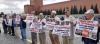
200 counter-protesters from around the country outnumbered some 30 members of the "pro-majority" Nationalist Movement who marched in Jena, LA, Jan. 21 to protest the holiday honoring Martin Luther King and the national campaign for the "Jena Six," black teenagers charged with beating a white classmate after black students were threatened with nooses left hanging from a tree at the school. The two groups met at the LaSalle Parish Courthouse, where one member of the New Black Panthers was arrested. (USA Today, Jan. 22) Barred by Jena police from marching with two shotguns they said they needed for protection, the Nationalist Movement now says it will hold a second march in the town to protest abridgment of its "second amendment rights." The group's leader Richard Barrett said he has filed suit in federal court to have the town and Mayor Murphy McMillin held in contempt of court for violating an order by US District Judge Dee Drell to not interfere with the march. "We do intend to defend the Second Amendment in the best and strongest way possible," Barrett said. (AP, Jan. 23)
Maoist terror in Bhutan?
A series of four bomb blasts rocked the tiny Himalayan kingdom of Bhutan over the weekend, wounding one person and damaging shops and businesses. One blast was in the Bhutanese capital, Thimphu; the others targeted shops and markets in the remote districts of Samste, Chukha and Dagana. The explosions come as the once rigidly closed monarchy is preparing its first national elections on March 24. Bhutan's authorities say they suspect one of three militant organizations based in refugee camps in nearby Nepal—the Bhutan Tiger Force, the Bhutan Maoists Party, and the Communist Party of Bhutan.
Uranium wars in Niger
In a statement on its website, the Nigérien Justice Movement (MNJ) claimed a Jan. 22 attack on Tanout in the Zinder district of Niger, in which at least three soldiers were killed, six wounded and nine others, including the town's prefect, were taken captive. (IRIN, Afriquenligne, Jan. 22) The French nuclear company Areva has signed a deal with Niger to open a second uranium mine in the west of the country, in return for increasing payments to the government by 50%. Protested MNJ commander Aghaly ag-Alambo: "The company has already worked here for 30 years but the local population hasn't even benefited from 1 percent of this wealth." (Financial Times, Jan. 15)
Mexico: NAFTA protests continue
Hundreds of Mexican campesinos, accompanied by 40 tractors, marched in Ciudad Juarez, in the northern state of Chihuahua, on Jan. 18 to launch the "Chamizal to the Zocalo" caravan, a 2,000-km ride to protest the elimination of tariffs on staples under the North American Free Trade Agreement (NAFTA). Organized by the Francisco Villa Campesino Resistance Movement, the caravan's route goes from El Chamizal Park, Juarez—at the border with El Paso, Texas—to Mexico City's main plaza, the Zocalo, where the protesters are to join a Jan. 31 demonstration against NAFTA planned by a broad range of groups.
Mexico: miners strike, teachers march
Thousands of members of the National Union of Mine and Metal Workers of the Mexican Republic (SNTMMRM) participated in an eight-hour national strike on Jan. 16 in support of workers at Grupo Mexico's giant copper mine at Cananea, in the northwestern state of Sonora. Police and soldiers had forcibly removed strikers from the mine on Jan. 12, one day after the Federal Conciliation and Arbitration Board (JFCA) ruled that the miners' five-month-old strike over safety conditions was illegal under Mexican labor law. The union won a temporary injunction on Jan. 12 allowing the strike to continue, but unofficial sources reported that the Sixth District Labor Court would probably terminate the injunction. Grupo Mexico insisted that at least 400 of the 1,300 workers had returned to the mine.
Guatemala: rights activists on hunger strike
Guatemalan human rights activist Amilcar Mendez and his wife, Miriam Dardon, began an open-ended hunger strike on Jan. 12 in Guatemala City to protest impunity for the 21,509 homicides that took place in the four-year administration of outgoing president Oscar Berger. One of the victims was the couple's son, José Emanuel "Pepe" Mendez Dardon, who was murdered on Aug. 17, 2007, on his way home from work in Guatemala City.
Lula shows Fidel the "love"
Brazilian president Luiz Inacio Lula da Silva met with Cuban president Fidel Castro Ruz on Jan. 15 during a 24-hour visit to Cuba and met twice with interim president Raul Castro, who has headed the government since the summer of 2006, when Fidel Castro withdrew from public functions because of undisclosed intestinal problems. The visit included the signing of financial and commercial agreements, such as credits for food purchases and the expansion of the Che Guevara nickel plant, and offshore oil exploration. Brazil is Cuba's second largest trading partner in Latin America, after Venezuela; annual trade is worth about $450 million.
Chávez arming Colombian guerillas?
Admiral Michael Mullen, chairman of the Joint Chiefs of Staff, said on a visit to Colombia Jan. 18 that the US is concerned about a Venezuelan military buildup, pointing to "what Mr. Chávez has done militarily in recent years and his acquisitions—both those he's made as well as those he states he's making for the future—high performance airplanes, modern submarines." President Hugo Chávez is negotiating with Russia to buy five diesel submarines that he says Venezuela needs to protect its extensive offshore oil drilling facilities. (AFP, Jan. 18) Days after Mullen's remarks, Miami's El Nuevo Herald cited anonymous Colombian intelligence officials as saying that the country's FARC and ELN guerillas are receiving ammunition manufactured in Venezuela. The officials said the 7.62mm AK-47 ammo recently captured from the FARC is produced by the state-owned Venezuelan Anonymous Military Industries Company (CAVIM). (Nuevo Herald, Bloomberg, Jan. 21)










Recent Updates
2 days 8 hours ago
3 days 4 hours ago
3 days 11 hours ago
6 days 11 hours ago
1 week 10 hours ago
1 week 12 hours ago
1 week 5 days ago
1 week 5 days ago
1 week 5 days ago
1 week 5 days ago