



Iraq Theater
Iraq: Yazidis targeted again
At least 250 and perhaps up to 500 are dead in four coordinated truck-bomb attacks that devastated Tal al-Azizziyah and Sheikh Khadar, two northern villages outside the town of Qahataniya near the Syrian border in Iraq's Nineveh province, Aug. 14. Residents and rescue workers continue pulling the dead and wounded from the rubble of hundreds of clay homes that collapsed when the massive bombs exploded. At least 350 are wounded. Rescue workers set up tents along the highway between the cities of Dohuk and Mosul to house the wounded after health ministry officials announced that hospitals in Sinjar, the nearest city, were overwhelmed. The area of devastation in one of the villages measured a half-mile in diameter. Many bodies are so mangled that they cannot be recognized. Ziryan Othman, minister of health for the Kurdistan region, likened the devastation to a natural disaster.
Protest at US embassy in Tokyo over slaying of Iraq civil resistance leader
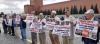
On Aug. 3, some 100 activists from the Japanese anti-war group Zenko (National Assembly for Peace and Democracy) gathered near the US embassy in Tokyo's central Shinbashi district to protest the July 4 slaying of Abdelhussein Saddam by US Special Forces troops in Baghdad. Abdelhussein had been the leader of the Safety Force, a civil patrol organized by the Iraq Freedom Congress (IFC) resistance organization to protect their communities from sectarian militias. Among those speaking were two IFC leaders who had been flown in for the 37th annual Zenko conference which opens this week. The principal banner read: "American ambassador, report this protest; give IFC immediate apology and compensation!" Another read: "Do US-Iraqi security forces promote civil rights or Big Brother thuggery? Abdelhussein found out!"
Saudis rewarded with high-tech arms for destabilizing Iraq
Media revealed this week that at a high-level meeting in Riyadh in January, Saudi officials confronted then-US Iraq envoy Zalmay Khalilzad with incriminating documents on Iraq's prime minister Nouri Kamal al-Maliki. One purported to be an early alert from al-Maliki to radical Shi'ite cleric Moqtada al-Sadr, warning him to lie low during a US troop surge. Another document purported to offer proof that Maliki was an Iranian agent. Khalilzad immediately protested to King Abdullah, contending that the documents were forged. Earlier this month, in an oblique reference to Saudi Arabia, Khalilzad charged in a New York Times op-ed: "Several of Iraq's neighbors—not only Syria and Iran but also some friends of the United States —are pursuing destabilizing policies." (NYT, July 27; The Scotsman, July 29) It seems the Saudis are following through on their longtime threats to arm the Sunni insurgents in Iraq. Nonetheless, on July 28, the Times reported that the US is preparing a major arms deal with Saudi Arabia and other Gulf states worth $20 billion over the next decade, including missile guidance systems, fighter jets and warships. (NYT, BBC, July 28)
Bush-Pelosi showdown over Iraq bases?
From Nancy Pelosi's blog, The Gavel, July 24:
House Votes to Ban Permanent Bases in Iraq
"The Democratic Congress will go on record – every day if necessary – to register a judgment in opposition to the course of action that the President is taking in Iraq. The Democratic Congress will go on record – every day if necessary – to fight for a redeployment of our forces as the central element of a New Direction strategy for Iraq." —Speaker Pelosi, 7/25/07
Halliburton shares hit new high
It's a beautiful time to be alive—if you're a Halliburton shareholder. From Reuters, July 23:
Halliburton Co., the world's second-largest oil services company, said on Monday second-quarter profit from continuing operations rose 19 percent, topping Wall Street views, helped by new international contracts and stronger demand from its customers.
Petraeus: "sustainable security" in Iraq —in 2009
A front-page New York Times story July 24 reveals details of a classified plan calling for achieving "localized security" in Baghdad by the summer of 2008—and "sustainable security" throughout Iraq by the summer of 2009. The document, known as the Joint Campaign Plan, anticipates a decline in US forces as the "surge" runs its course later this year or in early 2008, but it assumes continued US involvement to train and cooperate with Iraq forces. Drawn up by Gen. David H. Petraeus, the senior US commander in Iraq, and Ryan C. Crocker, the US ambassador, the plan has been briefed to Defense Secretary Robert M. Gates and Adm. William J. Fallon, the head of the Central Command. It is expected to be formally issued to officials in Washington this week. "The coalition, in partnership with the government of Iraq, employs integrated political, security, economic and diplomatic means, to help the people of Iraq achieve sustainable security by the summer of 2009," a summary of the campaign plan states.
Imperialist rodents threaten Iran, Iraq
Iranian intelligence operatives detained over a dozen squirrels found within the nation's borders earlier this month, claiming they were serving as spies for Western powers determined to undermine the Islamic Republic. "In recent weeks, intelligence operatives have arrested 14 squirrels within Iran's borders," state news agency IRNA reported. "The squirrels were carrying spy gear of foreign agencies, and were stopped before they could act, thanks to the alertness of our intelligence services." (YNet, July 17) Meanwhile in Iraq, British forces have denied rumors that they released a plague of ferocious man-eating badgers in the city of Basra. Several of the creatures, caught and killed by local farmers, have been identified by experts as honey badgers, which do not attack human beings unless threatened. UK military spokesman Major Mike Shearer said: "We can categorically state that we have not released man-eating badgers into the area." (BBC, July 12)
Iraq: insurgents form new front —minus al-Qaeda?
Writing for The Guardian July 19, Seumas Milne relates a revealing meeting with Iraqi insurgent leaders in Damascus, who say they are uniting in a new front, to be called the Political Office for the Iraqi Resistance. They say a founding congress is in the works, with the aim of establishing a credible armed resistance and isolating al-Qaeda elements bent on sectarian warfare. They even claim that there has been indirect contact with France about opening a public office there. The constituent groups are named as Iraqi Hamas, the 1920 Revolution Brigades, Ansar al-Sunna, Jaish al-Islami, Jaish al-Mujahideen, Jama' and Jaish al-Rashideen.








Recent Updates
1 day 7 hours ago
2 days 10 hours ago
3 days 16 hours ago
4 days 8 hours ago
4 days 8 hours ago
4 days 8 hours ago
5 days 15 hours ago
5 days 15 hours ago
5 days 15 hours ago
5 days 15 hours ago