




Southern Cone
Argentina: thousands protest disappearance
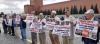
Tens of thousands of people mobilized throughout Argentina on Sept. 20 to demand that human rights witness Jorge Julio Lopez, who disappeared on Sept. 18, 2006, be returned alive. More than 20,000 people marched in Buenos Aires from the Congress to the Plaza de Mayo; marches also took place in La Plata, Rosario and Cordoba. The Memory, Truth and Justice Encounter, which organized the Buenos Aires event, read a document at the Plaza de Mayo declaring: "With the struggle we have achieved the repeal of the impunity laws and the ongoing trials of more than 300 human rights violators; with the struggle we won the sentencing of Miguel Osvaldo Etchecolatz to a life sentence in a common prison until the end of his days, and that for the first time a court recognizes that there was a genocide in our country. The price the genocidal murderers want to make us pay for these victories is the kidnapping and disappearance of one of the witnesses of that trial, our comrade Jorge Julio Lopez." (Argentina Indymedia, Sept. 20)
Chile: one killed on coup anniversary
Some 5,000 people, according to police estimates, marched in Chile on Sept. 9 to mark the anniversary of the military coup in which Gen. Augusto Pinochet Ugarte overthrew democratically elected socialist president Salvador Allende on Sept. 11, 1973. The peaceful march—the first of the annual commemorations to take place since Pinochet's death on Dec. 10, 2006—was met with a heavy police presence and street closures. The march ended with a rally at the Santiago General Cemetery, where a memorial honors the nearly 3,000 people who were killed or disappeared under Pinochet's 17-year military regime. During the rally, several hooded individuals split off from the larger group and provoked incidents with the police, who then tried to break up the demonstration with tear gas and water cannons. Some demonstrators responded with rocks and sticks. More than 100 people were arrested. (AFP, Sept. 9 via La Jornada, Mexico)
Argentina: jailed activists on hunger strike
On Sept. 7, hundreds of Argentines rallied in the Plaza de Mayo in Buenos Aires in solidarity with jailed activists Fernando Esteche and Raul Lescano, who have been on hunger strike since Aug. 21 at the Ezeiza prison. Esteche and Lescano, members of the radical leftist group Quebracho Patriotic Revolutionary Movement, are demanding they be released pending trial. The two were jailed on Apr. 5 for a vandalism attack on the party offices in Buenos Aires of Jorge Sobisch, rightwing governor of the southwestern province of Neuquen, during a march organized by Quebracho to protest the police killing of high school chemistry teacher Carlos Fuentealba. Police shot Fuentealba in the head at close range with a tear gas canister at a demonstration on Apr. 4 in the provincial capital of Neuquen; he died on Apr. 5. (Quebracho news release, Sept. 8)
Chile: protest "Pinochet" policies
More than 670 people were arrested and some 50 people were injured in Santiago and other Chilean cities on Aug. 29 in massive protests against the economic policies of President Michelle Bachelet. The Unitary Workers Confederation (CUT), which organized the protest, charged that Bachelet was following economic policies inherited from the 1973-1990 military dictatorship of Gen. Augusto Pinochet Ugarte; the protesters also demanded the resignation of Finance Minister Andres Velasco. The police attacked marchers with tear gas and water cannons; the injured included two camera operators, National Literature prize-winning poet Raul Zurita and Senator Alejandro Navarro from Bachelet's own Socialist Party.
Uruguay: victory in squatters struggle
On July 28, thousands of people marched in Montevideo, Uruguay, to demand the repeal of Law 18.116, which modifies the penal code to impose prison sentences of between three months and three years on people who take part in the occupation of a property not their own. The march was called by the Uruguayan Federation of Housing Cooperatives for Mutual Aid (FUCVAM), together with the Union of Sugar Workers of Artigas (UTAA), the September 10, 1815 Movement of Tacuarembo and residents of the Las Laminas neighborhood of Bella Union in Artigas department.
Chile: strikes paralyze copper mines
Chile's Codelco suspended copper production for an entire day at one of its four mining divisions July 10 and cut back operations at another plant following violent protests by striking workers, in the most serious flare-up yet in a two-week stand-off between management and subcontracted workers who are demanding improved pay and conditions.
Argentina: rights trial opens; witness found dead?
Argentina is preparing for a new human rights trial for crimes committed during the 1976-1983 military dictatorship. Just days before the start of the latest trial, Argentine police discovered a body thought to be that of a missing witness. Police early July 3 found a body of a man who they believed to be Julio Lopez, the key witness who went missing last year following the land mark conviction of a police official who ran clandestine torture centers.
Brazil: protests block canal project
On June 26, nearly 1,200 people camped out on the BR 428 highway between Cabrobo and Oroco municipalities in Brazil's Pernambuco state to block national army engineering battalions from proceeding with the construction of a canal project on the Sao Francisco river. The protesters plan to remain at the site indefinitely; they are also demanding return of the Mae Rosa estate to its rightful inhabitants, the indigenous Truka people.








Recent Updates
15 hours 12 min ago
15 hours 15 min ago
15 hours 17 min ago
15 hours 21 min ago
15 hours 25 min ago
15 hours 30 min ago
15 hours 34 min ago
15 hours 42 min ago
16 hours 2 min ago
3 days 11 hours ago